Tiếng Anh 9
Tiếng AnhLớp 9Phần 9. Unit 7: Natural wonders of the world

Getting Started

Mục tiêu bài học

  • Understand the topic and the purpose of a short exchange.

Bài giảng

Meet the topic

Huy: Could you tell me whether the path is open?
Guide: Let me check the latest notice.
Huy: Thank you. We do not want to use an unsafe route.

Huy read a visitor guide about a limestone valley before a school trip. The guide explained that caves and rock formations developed over a very long time. It also asked visitors to stay on marked paths and leave stones where they were. Huy wondered whether the easiest path was open after heavy rain, so he contacted the visitor centre instead of relying on an old message. The staff confirmed a safe route and advised the group to bring water. Huy prepared a short talk about why preservation matters. A natural wonder, he concluded, is not only a place for photographs. It is a landscape whose living systems and geological history deserve care.
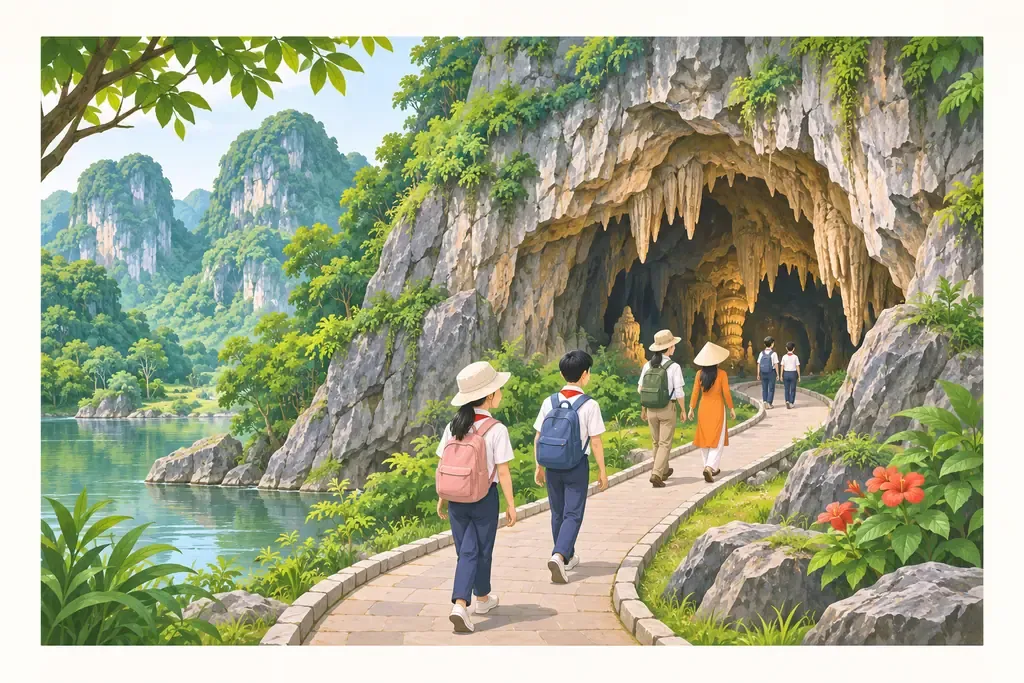
A limestone cave and a safe visitor path.

Describe the visible setting. Separate what you can see from what the reading tells you.

Read actively

Read the exchange once for the setting, then mark the question and response. Notice the useful expressions, not just separate words. In this unit, connect the topic to these phrases: limestone, landscape, magnificent, formation.

Report a yes/no question with asked + if/whether + subject + verb, using statement order. “Is the path open?” → She asked if the path was open. In a past reporting context, backshift present to past and can to could; change pronouns/time expressions when the context requires it. Do not keep do/does/did or invert the subject.

Khái niệm chính

Language focus
Report a yes/no question with asked + if/whether + subject + verb, using statement order. “Is the path open?” → She asked if the path was open. In a past reporting context, backshift present to past and can to could; change pronouns/time expressions when the context requires it. Do not keep do/does/did or invert the subject.

Ví dụ

  1. Ví dụ 1

    “Is the cave open?” She asked ___.

    Xem lời giải

    if the cave was open Reported question uses if + subject + verb.

Từ vựng

  • limestone

    đá vôi

    Limestone can form dramatic caves.

  • landscape

    cảnh quan

    The landscape includes mountains and rivers.

  • magnificent

    tráng lệ

    The cave entrance is magnificent.

  • formation

    cấu trúc hình thành

    A rock formation can take a long time to develop.

  • destination

    điểm đến

    The valley is a popular destination.

  • preservation

    sự bảo tồn

    Preservation protects a site for the future.

  • slope

    sườn dốc

    Stay on the path on a steep slope.

  • snowy

    phủ tuyết

    The mountain has a snowy peak.

Ghi nhớ

Report a yes/no question with asked + if/whether + subject + verb, using statement order. “Is the path open?” → She asked if the path was open. In a past reporting context, backshift present to past and can to could; change pronouns/time expressions when the context requires it. Do not keep do/does/did or invert the subject.

Dễ nhầm

  • Do not translate every word separately; preserve the meaning of whole phrases.
  • A fluent opinion still needs evidence when it makes a factual claim.

Bài tập

Đã đúng 0/6 câu

  1. Câu 1Mức 1Trắc nghiệm 1 đáp án

    Huy: Could you tell me whether the path is open?
    Guide: Let me check the latest notice.
    Huy: Thank you. We do not want to use an unsafe route.

    What does the first speaker do?

  2. Câu 2Mức 2Ghép nối

    Match the topic words to their meanings.

    Chạm một ý bên trái rồi chạm ý tương ứng bên phải để ghép cặp.

  3. Câu 3Mức 1Trắc nghiệm 1 đáp án

    Huy read a visitor guide about a limestone valley before a school trip. The guide explained that caves and rock formations developed over a very long time. It also asked visitors to stay on marked paths and leave stones where they were. Huy wondered whether the easiest path was open after heavy rain, so he contacted the visitor centre instead of relying on an old message. The staff confirmed a safe route and advised the group to bring water. Huy prepared a short talk about why preservation matters. A natural wonder, he concluded, is not only a place for photographs. It is a landscape whose living systems and geological history deserve care.

    Who is the main named learner or participant?

  4. Câu 4Mức 1Trắc nghiệm 1 đáp án

    Huy read a visitor guide about a limestone valley before a school trip. The guide explained that caves and rock formations developed over a very long time. It also asked visitors to stay on marked paths and leave stones where they were. Huy wondered whether the easiest path was open after heavy rain, so he contacted the visitor centre instead of relying on an old message. The staff confirmed a safe route and advised the group to bring water. Huy prepared a short talk about why preservation matters. A natural wonder, he concluded, is not only a place for photographs. It is a landscape whose living systems and geological history deserve care.

    Which setting or activity is central to the account?

  5. Câu 5Mức 2Điền vào chỗ trống

    Complete the word for “đá vôi”: .

  6. Câu 6Mức 1Trắc nghiệm 1 đáp án

    “Is the cave open?” She asked ___.

  7. Câu 7Mức 3Tự luận

    In two or three connected English sentences, explain why natural wonders of the world matters. Use at least two of these words or phrases: limestone, landscape, magnificent, formation.

    0 từ

    0/10 ảnh

    Có thể chụp nhiều trang. Ảnh được lưu cùng bài làm và giáo viên sẽ chấm trên ảnh.

    Vẽ bài làm

    Ảnh bài làm

    Cuộn chuột hoặc chụm hai ngón để phóng to · kéo để di chuyển · phím R để xoay

  8. Câu 8Mức 3Tự luận

    Huy: Could you tell me whether the path is open?
    Guide: Let me check the latest notice.
    Huy: Thank you. We do not want to use an unsafe route.

    Continue this exchange with one useful reply and a polite closing.

    0 từ

    0/10 ảnh

    Có thể chụp nhiều trang. Ảnh được lưu cùng bài làm và giáo viên sẽ chấm trên ảnh.

    Vẽ bài làm

    Ảnh bài làm

    Cuộn chuột hoặc chụm hai ngón để phóng to · kéo để di chuyển · phím R để xoay